Road Salt Is Quietly Eating Your Driveway — Here's the Spring Reset
Every winter, Minnesota puts hundreds of thousands of tons of chloride on its roads, and a share of it rides into your driveway on your tires, your boots, and the plow's spray. By April it shows up as a white haze you might hose off — or ignore. But the haze is the visible fraction of a process happening inside the slab, and whether you interrupt it each spring is a meaningful part of whether your driveway lasts 20 years or 40.
What Salt Actually Does to Concrete
Concrete is porous — think very hard sponge. Three things happen when chloride brine soaks in:
1. Freeze-thaw on overdrive. Plain water in those pores freezes once per cold snap. Brine lowers the freezing point, so on every marginal day the pore water cycles freeze–thaw–freeze where it would have stayed frozen. Each cycle is a tiny hydraulic jack. Multiply by a Duluth winter and the surface starts popping off in flakes — that's scaling — or in coin-to-palm-sized chunks: spalling.
2. Permanent moisture attraction. Chlorides are hygroscopic — they pull humidity into the slab and keep it damp. A salty driveway is a wet driveway, all year, quietly continuing the cycle.
3. Rebar corrosion. If your slab has steel in it, chloride is its mortal enemy. Rusting steel expands up to several times its volume and cracks concrete from within. This is why bridge decks get washed — the same chemistry applies at house scale.
Read Your Driveway: The Damage Ladder
| What you see | What it means | What to do |
|---|---|---|
| White haze / crusty film | Salt load on and in the surface — pre-damage | Thorough wash now; cheap and fully reversible |
| Light surface flaking (scaling) | Freeze-thaw has started on the cream layer | Wash + penetrating sealer to stop progression |
| Pits and popped chunks (spalling) | Cycle is established | Wash, seal, patch the worst; plan resurfacing in time |
| Rust stains bleeding from cracks | Embedded steel corroding | Concrete contractor conversation, sooner not later |
Why a Garden Hose Doesn't Do It
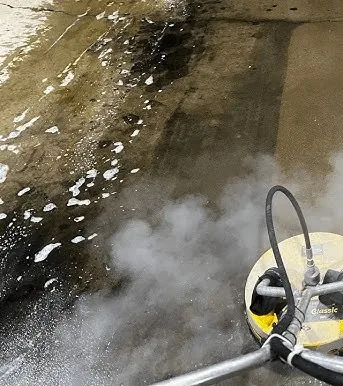
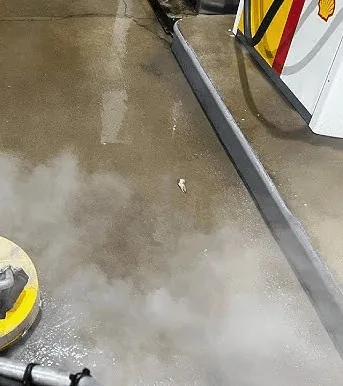
A hose rinses the crystals you can see and leaves the brine in the pore structure — the part doing the damage. Getting salt out of concrete takes heat, detergent dwell, and controlled pressure: our concrete rigs run hot water through rotary surface cleaners, which dissolve the chloride film and flush the top of the pore structure evenly (no zebra stripes from wand strokes). Hot water is also what releases the oil drips and tire-track grime that cold rentals just push around. Concrete is the one surface where real pressure belongs — see the PSI chart — and a standard double driveway runs about $110–$180.
Hot-water driveway wash — and bundle the house or gutters while the truck's there. Free written quote, usually same day.
Get a Concrete Washing QuoteThe Seal: Your Driveway's Winter Coat
Washing removes this winter's salt; a penetrating sealer (siloxane/silane type) blocks next winter's. It soaks into clean, dry concrete and chemically repels water and brine without changing the look or making the surface slippery. Applied every 3–5 years, it's the difference-maker for Northland slabs. Two rules: never seal over a salty/dirty slab (you lock the chloride in), and skip the glossy topical sealers on driveways — they peel under plow blades and get slick under snow.
Next Winter, Cheaper: Salt Smarter
Plain rock salt (sodium chloride) is the cheapest and the harshest, and it stops working below about 15°F anyway. Calcium chloride works in deep cold and at lower doses; sand adds traction with zero chemistry. Best practice is shoveling early and often so you barely need melt product at all — and never use fertilizer or "ice melt blends" with ammonium sulfate, which attacks concrete directly. Whatever you use, the spring wash closes the loop.
FAQ
Does road salt really damage concrete?
Yes — mainly by multiplying freeze-thaw cycles inside the slab's pores, which pops the surface apart (scaling/spalling). It also keeps concrete damp and corrodes embedded steel.
What's the white residue every spring?
Dried brine plus efflorescence. The salt fraction keeps drawing moisture into the slab all summer unless it's washed out properly.
Why hot water?
Salt and oil dissolve and release dramatically faster in hot water. Cold rentals move dirt around; hot-water surface cleaning lifts the salt out of the pores.
Should I seal after washing?
In our climate, yes — penetrating sealer on clean, dry concrete every 3–5 years is the best spalling defense there is. Never seal over salt.
Spring wash now, sealed before fall. We'll quote both in one visit.
Request a Free QuoteRelated: Salt Stain Removal · Concrete Cleaning Guide · Spring Checklist · 2026 Price Guide
© 2026 Up North Pressure Washing · Duluth, MN · Service Area · Pricing